Category Archives: Peak Oil

Oil Price Forecasts: An Example from 1983


The Hubbert peak oil forecast assumes the production of oil (or gas or other commodities) follows a logistics curve from initial production to final resource exhaustion. The area under the “Hubbert Peak Oil” curve represents the total oil to be produced, or the total oil resource that has and will be exploited. The curve represents the volume of oil produced per unit time. In most forecasts, years or decades represent the unit time. We can read the curve as barrels of oil produced per year or per decade.


Economists consider supply and demand to be functions of price. The volume of a product consumed in day or a year or other time period is thus considered to be a function of the average price for that time period. If we want to perform a forecast of peak oil or ultimate oil consumption for a oil producing province, or a country, or the world, then we would like to have a forecast of the oil price for the remaining history of oil production. This is a difficult problem. Consider an example from 1983:
BrentPrice

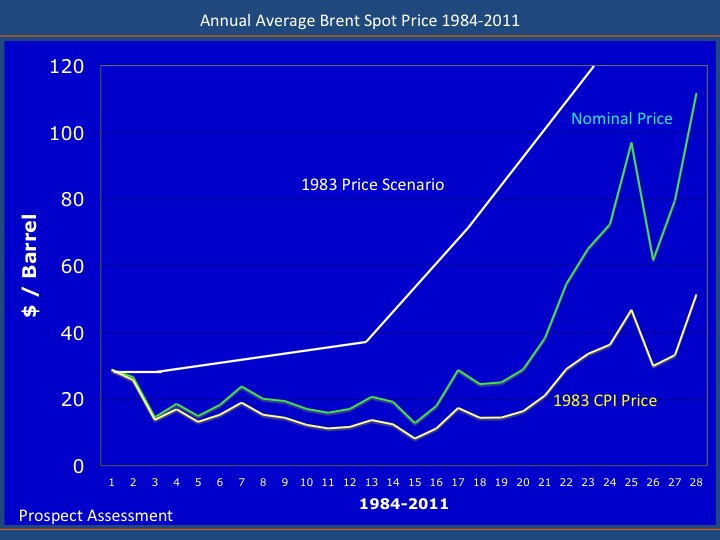
The figure shows a price forecast made by a major oil company. It was used to evaluate potential projects in a variety of basin and countries. It was also used to forecast company revenues from existing production. Discussions with colleagues working in  other companies and host governments at the time suggested that this scenario was similar to scenarios used throughout the industry.

At the time of the forecast, Brent crude traded for about $30 a barrel. Although the price was forecast to remain flat for a few years, by 1986 it was expect to begin rising modestly each year until about 1997. From then until the end of the forecast period, it was forecast to rise to $120 a barrel.

The figure shows the actual price oil in nominal terms through 2011. The nominal price of oil fell to below $20 a barrel for 16 years, with only a few brief intervals above $20. It reached its nadir in December, 1998 at less than $10 a barrel. (http://www.eia.gov/dnav/pet/hist/LeafHandler.ashx?n=PET&s=RBRTE&f=M)

From then it rose, with one pause, to over $100. Although it never averaged $120 per barrel for an entire year, it did average over $120 a barrel in April 2011 and March 2012.

Nominal prices do not reflect inflation. For much of the forecast period inflation fell, becoming quite low in recent years. Using the CPI to discount the nominal price to 1983 dollars shows the price never came close to $100 a barrel, and has only recently approached $50 a barrel in 1983 dollars.

From today’s perspective, the error in the 1983 forecast may seem obvious. Oil production was increasing in North America and the North Sea at that time. OPEC members were cheating on their quotas. The high oil prices of the previous decade led to increased transportation fuel efficiency, as well as fuel substitution in many sectors of the economy.

In 1970, however, it seemed that oil would remain below $5 a barrel for many years. The Arab oil boycott just a few years later was not foreseen. For many years a nominal price above $3 a barrel seemed far fetched.

Not knowing the future price of oil, it is very problematic to assume the future production of oil will follow a simple logistic curve. This should give pause to those who predict either a near term collapse in production or a future with abundant supplies.
 

The Problem with OPEC Reported Reserves

MEOilReserves OPED

The Organization of Petroleum Exporting Countries (OPEC) uses the share of total proven reserves to allocate production quotas among its members. The proven reserves are reported by each member country to OPEC. The country with the largest reserves is granted the largest share of the quota. From the founding of OPEC, Saudi Arabia has reported the largest oil reserves.

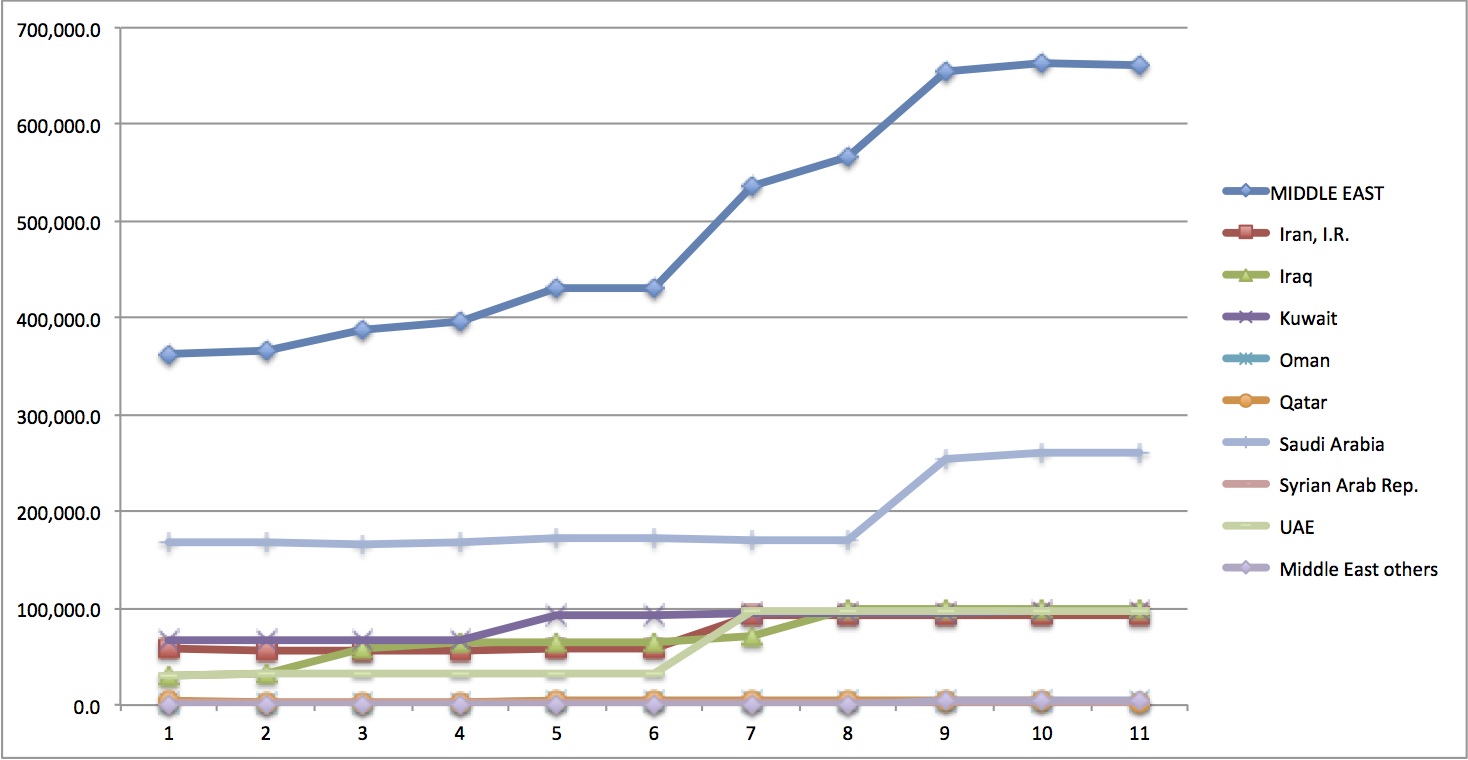
The figure at the top of this post is an Excel graph made from data reported by OPEC for the entire world. The spreadsheet is found here:

http://www.opec.org/library/annual%20statistical%20bulletin/interactive/2004/filez/XL/T33.HTM

The units shown on the vertical axis are in thousands of barrels of oil. The horizontal axis shows eleven years from 1980 thru 1990. Between 1983 and 1984, Kuwait’s reserves jump from 67 billion barrels to 92.7 billion barrels. The Wafra oil field was discovered in 1984 and accounts for this increase.

Between 1985 and 1986 Iran’s reported reserves jumped from 59 billion barrels to 92.86 billion barrels. Iraq’s oil reserves jumped from 72 billion barrels to 100 billion barrels. Iran and Iraq were engaged in a protracted land war between 1980 and 1987, hindering exploration in both countries.

The United Arab Emirates reserves jumped from 32.9  to 97.2 billion barrels. Between 1987 and 1988 Saudi Arabia reported reserves jumped from 169.6 to 255 billion barrels.

These very large oil reserve additions should reflect the discovery of very large oil fields.  Although a number of discoveries were reported during the 1980’s, none approach the size of pre-1980 discoveries. So perhaps the increased reserves reflect improved oil recovery techniques.

Skeptics hold a different view.  Consider the oil price history reported by the EIA for this period:

http://www.eia.gov/dnav/pet/hist/LeafHandler.ashx?n=pet&s=isa4990008&f=a

The average price of Saudi light crude landed in the US in 1982 was $35.65/barrel. In 1985 it was $25.35/barrel. In 1986 it was $13.05/barrel. In 1988 it was $14.04/barrel. The skeptics claim the increased reserves reported by OPEC countries, especially those in the Middle East, were not due to major discoveries or improved recovery techniques.

The skeptics claim the reports were a response to declining oil sales revenues. The falling oil prices reduced oil revenues, so OPEC agreed to reduce its production in order to restore higher oil prices.  Rather than accept lower production quotas, member states increased their reported reserves in order to obtain larger shares of the reduced quotas. As their reports are not audited by OPEC, no one outside of the state oil ministries really knows what their proven oil reserves are.

And without a reliable estimate of proven global oil reserves, it is not possible to perform a global peak oil forecast using the method employed by M. King Hubbert.

The Peak Oil Problem

Hubbert Slide


“Peak Oil” is a topic that returns to public view whenever the price of oil increases above its most recent price range. The concept of peak oil is often credited to M King Hubbert, a geologist who worked for Shell Oil in Houston for half of his career, and then worked for the USGS for the second half of his career. He saw oil supply forecasts as a planning tool to be used by Shell’s management. At the USGS he saw the forecasts as a useful strategic planning tool to be used by US policy makers. His USGS forecast was rejected by resource assessment geologists within the Survey. He predicted a peak of oil production from conventional oil fields in the Lower 48 states and near shore waters to occur in 1970. This did occur, and subsequently his forecasts for both US and global production gained a wide audience, including both supporters  and skeptics.

The lower 48 forecast was made after many decades of production using a database compiled from a major producing company. Hubbert had access to a reasonably complete knowledge of region’s geology, production techniques, and production history.

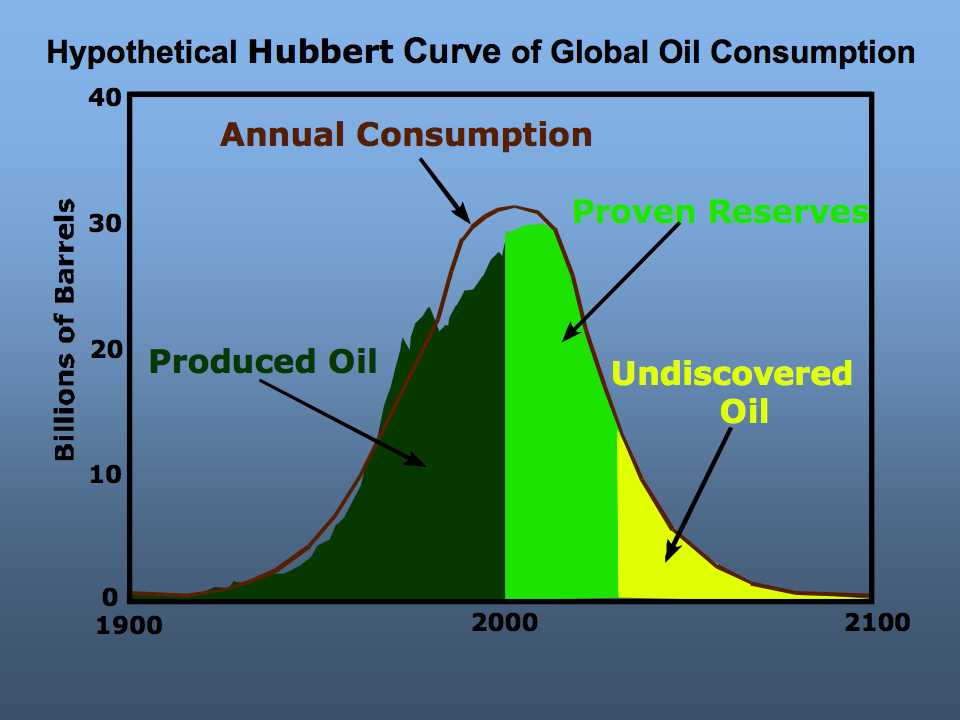
A similar knowledge base does not exist does to support a global forecast, as Hubbert knew very well. The figure shown above is modified from Hubbert’s prediction of global oil production from conventional oil fields made in 1969. The dark green area shows global production from 1900 to 2000 as compiled by Ron Charpentier of the USGS resource assessment group in Denver. The light green area shows proven reserves as reported by oil companies and national governments in 2000. These data are compiled by British Petroleum and published every year. The yellow area shows an estimate of undiscovered reserves estimated by the USGS as of 2000. The estimate is the mean of a forecast that ranges from very likely to be discovered ie more than a 95% of being discovered, to very unlikely of being discovered ie less than a 5% chance of being discovered.

There is little discussion regarding the quantity of oil produced to date in the figure. The volume is so large that unreported production would not change the graph. There is some real doubt as to the quantity that is proven but not produced. The doubt arises from the nature of the OPEC production quota setting process. Some observers do not believe all of the reports issued by OPEC members. Finally, the volume of oil to be discovered in the future is unknown. The technology and estimating processes simply do not provide a narrow estimate of future discoveries.

The “peak oil problem” thus seems to be a debate over the quantity of proven reserves and undiscovered oil. If you know these estimates, you simply plug in the total oil endowment of the planet into an equation, and a forecast results. If you disagree with other forecasters’ estimates of these volumes, then your forecast will differ from their forecasts.

But is this all there is to the peak oil problem? What about the curve that rises from zero, reaches a peak of some duration, and then falls to zero? This is an example of a logistics curve, which can be represents a differential equation. Hubbert expressed some doubts about this mathematical model for oil production. Note the historic production trend shown by the dark green area. Production rises and falls from 1900 to 2000. Some production changes reflect increasing supplies. Some changes reflect disruptions caused by economic recessions and wars. At every point in time on the historic production curve (the dark green area), the quantity produced and consumed reflects the effect of price on supply and demand. This raises an important question: can we predict the price of oil in the distant future? Can we predict the price of oil five, ten, 50 years from now? Can we relate such predictions to resulting future supply and demand?

The “Peak Oil Problem” is a problem with four variables, two or perhaps three of which cannot be known. We can agree on the volume of oil produced to date. There is some disagreement about the volume of discovered oil that has not been produced yet. We really don’k know how much oil will be discovered in the future. And no one has been able to predict the price of oil into the future. Many failed oil companies and commodity traders attest to this last fact.