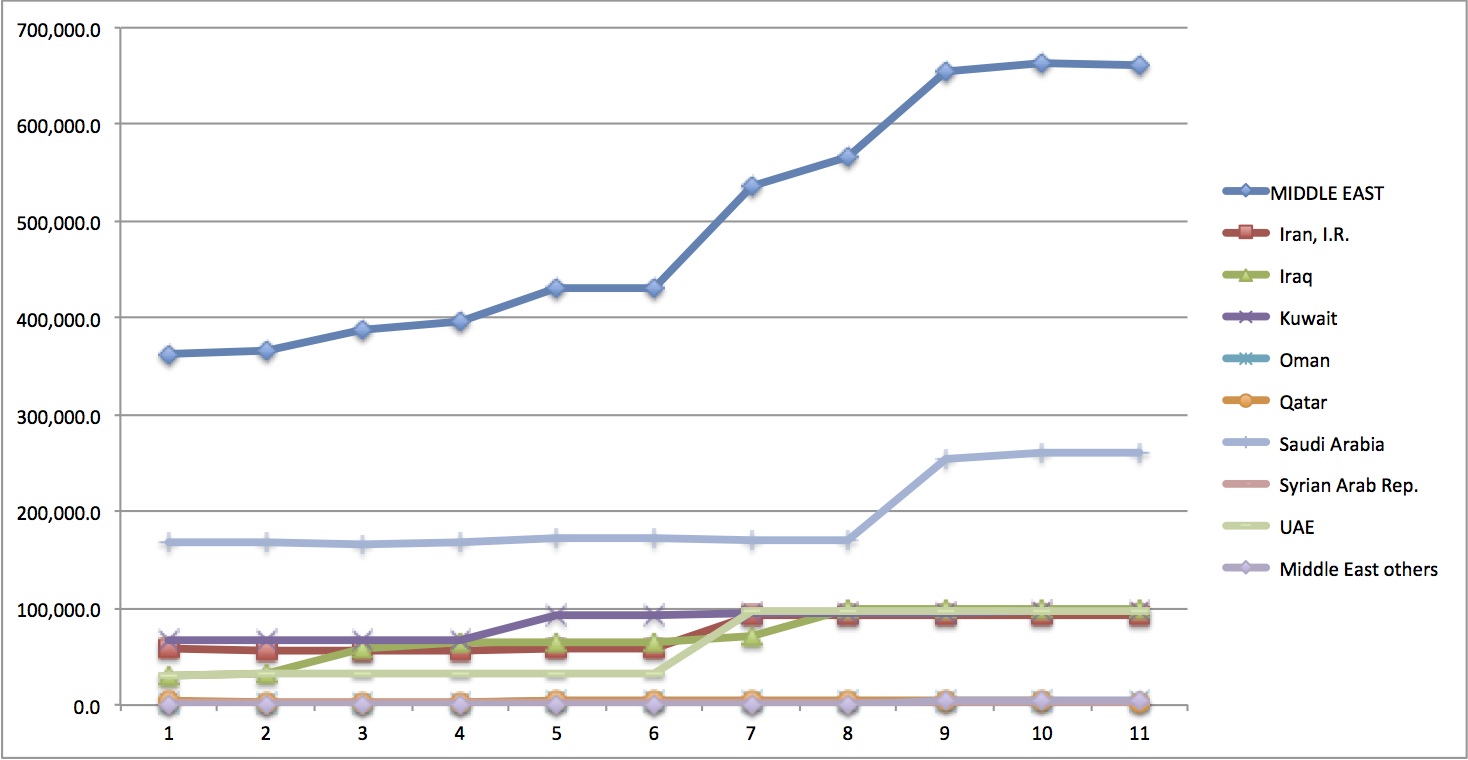
The Organization of Petroleum Exporting Countries (OPEC) uses the share of total proven reserves to allocate production quotas among its members. The proven reserves are reported by each member country to OPEC. The country with the largest reserves is granted the largest share of the quota. From the founding of OPEC, Saudi Arabia has reported the largest oil reserves.
The figure at the top of this post is an Excel graph made from data reported by OPEC for the entire world. The spreadsheet is found here:
http://www.opec.org/library/annual%20statistical%20bulletin/interactive/2004/filez/XL/T33.HTM
The units shown on the vertical axis are in thousands of barrels of oil. The horizontal axis shows eleven years from 1980 thru 1990. Between 1983 and 1984, Kuwait’s reserves jump from 67 billion barrels to 92.7 billion barrels. The Wafra oil field was discovered in 1984 and accounts for this increase.
Between 1985 and 1986 Iran’s reported reserves jumped from 59 billion barrels to 92.86 billion barrels. Iraq’s oil reserves jumped from 72 billion barrels to 100 billion barrels. Iran and Iraq were engaged in a protracted land war between 1980 and 1987, hindering exploration in both countries.
The United Arab Emirates reserves jumped from 32.9 to 97.2 billion barrels. Between 1987 and 1988 Saudi Arabia reported reserves jumped from 169.6 to 255 billion barrels.
These very large oil reserve additions should reflect the discovery of very large oil fields. Although a number of discoveries were reported during the 1980’s, none approach the size of pre-1980 discoveries. So perhaps the increased reserves reflect improved oil recovery techniques.
Skeptics hold a different view. Consider the oil price history reported by the EIA for this period:
http://www.eia.gov/dnav/pet/hist/LeafHandler.ashx?n=pet&s=isa4990008&f=a
The average price of Saudi light crude landed in the US in 1982 was $35.65/barrel. In 1985 it was $25.35/barrel. In 1986 it was $13.05/barrel. In 1988 it was $14.04/barrel. The skeptics claim the increased reserves reported by OPEC countries, especially those in the Middle East, were not due to major discoveries or improved recovery techniques.
The skeptics claim the reports were a response to declining oil sales revenues. The falling oil prices reduced oil revenues, so OPEC agreed to reduce its production in order to restore higher oil prices. Rather than accept lower production quotas, member states increased their reported reserves in order to obtain larger shares of the reduced quotas. As their reports are not audited by OPEC, no one outside of the state oil ministries really knows what their proven oil reserves are.
And without a reliable estimate of proven global oil reserves, it is not possible to perform a global peak oil forecast using the method employed by M. King Hubbert.
 consumingtheearth