Category Archives: OPEC

The November 2014 OPEC Meeting

OPEC concluded the November meeting last week by agreeing to leave their production quota unchanged. A press release was issued after the meeting: http://www.opec.org/opec_web/en/press_room/2938.htm

The most important paragraphs read:

The Conference reviewed the oil market outlook, as presented by the Secretary General, in particular supply/demand projections for the first, second, third and fourth quarters of 2015, with emphasis on the first half of the year.  The Conference also considered forecasts for the world economic outlook and noted that the global economic recovery was continuing, albeit very slowly and unevenly spread, with growth forecast at 3.2% for 2014 and 3.6% for 2015.

The Conference also noted, importantly, that, although world oil demand is forecast to increase during the year 2015, this will, yet again, be offset by the projected increase of 1.36 mb/d in non-OPEC supply.  The increase in oil and product stock levels in OECD countries, where days of forward cover are comfortably above the five-year average, coupled with the on-going rise in non-OECD inventories, are indications of an extremely well-supplied market.

Recording its concern over the rapid decline in oil prices in recent months, the Conference concurred that stable oil prices – at a level which did not affect global economic growth but which, at the same time, allowed producers to receive a decent income and to invest to meet future demand – were vital for world economic wellbeing.  Accordingly, in the interest of restoring market equilibrium, the Conference decided to maintain the production level of 30.0 mb/d, as was agreed in December 2011. 

The New York Times, Financial Times, and other news sources report some disagreement among OPEC’s members about this decision. Some countries, such as Algeria, Iraq, Venezuela, and Nigeria,  would prefer to reduce production in order to raise the spot price. Presumable the reduction would be made by Saudi Arabia.

The Saudis are unwilling to do this, which has produced some speculation about their motives at this time. One line of thought is that the Saudis are in league with the US government: by driving down the price of oil, the Russian Ruble declines and Russian foreign income declines. The other line of thought is that the Saudis wish to preserve their sales to the US.

I prefer the latter scenario, which echoes the dispute between Venezuela and Saudi Arabia from 1998 to 2001. At that time oil production increased in Venezuela due to a field reactivation program executed by PEDEVSA, the state oil company. The program was first announced in 1989 and required several years to come into effect. Under this program, international oil companies (EXXON, BP, and so on) entered into contracts to improve production from existing fields and to explore for new fields within defined concession areas. The resulting increased oil production entered the US market, displacing Saudi exports to the US.

Saudi Oil Imports

The chart above shows Saudi oil imports to the US from 1990 to 2014. Common wisdom in some quarters is that the Saudis want to export one million barrels per day to the US as a matter of foreign policy. The decline at the beginning of the period represents the displacement of Saudi imports by Venezuelan imports. The steep increase between 1999 and 2002 represents the increase in Saudi production intended to reduce the price of oil and remove more expensive Venezuelan crude from the US market. The steep fall at the end of the chart represents the displacement of Saudi crude by US shale oil production, primarily from the Bakken Formation in North Dakota.
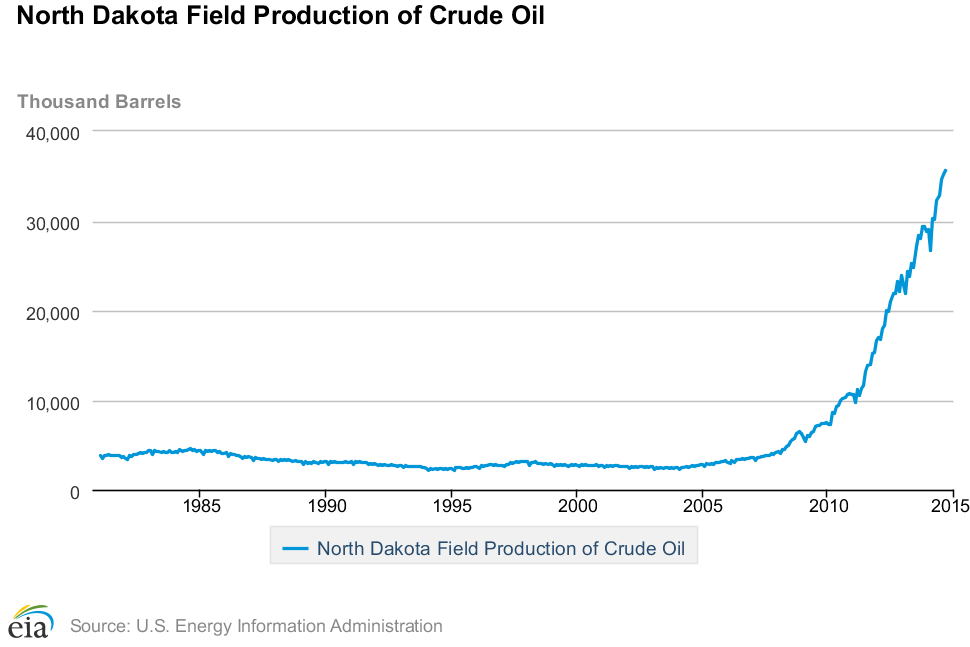
 

chart-2


This chart shows oil production from North Dakota between 1990 and 2014. The steep increase in production beginning in 2008 represents new shale oil production from the Bakken Formation.

Why did the Saudis wait six years to respond to the increase in Bakken production? Between 2008 and 2012 Bakken production replaced declining oil production within the US, primarily from the Alaska North Slope fields. During the past two years, increasing Bakken and Eagle Ford oil shale production has exceeded field declines elsewhere in the US. Some foreign oil was displaced by the increase in US production, and some of the oil was imported from Saudi Arabia.

Today West Texas Intermediate crude oil closed down 94 cents at $65.84/barrel. The price of oil has been declining for several months, as noted in earlier posts. How much lower can it go before oil shale wells are shut in?

Only the well operators know the answer to this question, and it varies for each well. These shale oil wells begin production at a high daily rate, but after a three to nine months the production rate declines rapidly. Once the price oil sinks below the cost of shale oil production, we can expect a fairly rapid fall in production over the course of year or so. During this time, oil imports will likely rise.

There is a leading indicator for those looking at the shale oil play from the outside: the rig count. When operators decide there is no financial incentive to drill new production wells, they stop contracting drilling rigs.  Baker Hughes publishes a survey of rigs every week:

http://phx.corporate-ir.net/phoenix.zhtml?c=79687&p=irol-rigcountsoverview

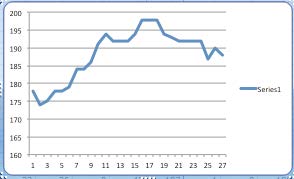
For reference, below is a chart of recent North Dakota rig counts:
Bakken 6Jun14 to 4 Dec14

The above chart shows the number of rigs operating in North Dakota from June 6 to December 4, 2014. Good weather during the spring and summer typically results in an increase in rig use. Winter weather typically impedes the movement of both rigs and supplies to new drill sites, so the rig count declines.

For context, here is a longer term view of North Dakota rig counts:

Bakken Wells 4Feb11 to 5Dec14 2014

This chart shows the rig count in North Dakota from March, 2011 to December, 2014. The peak in rig count reflects the entry of new players as operators realized there was a resource to exploit in 2012-2013. The interesting question over the coming months is this: if the price of oil falls, will these operators stop drilling wells? Will the rig count fall dramatically?
 

The Recent Decline in Crude Oil Prices

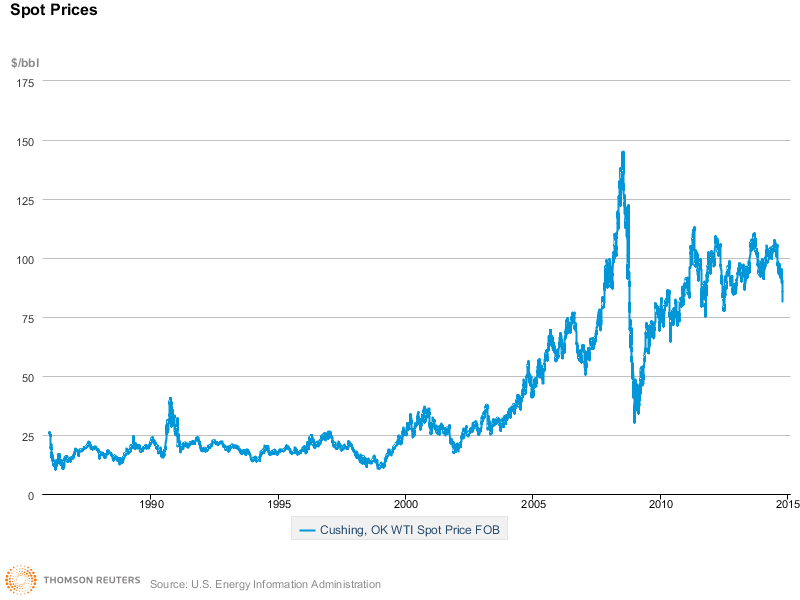
The price of crude oil has recently fallen from over $100/barrel to below $85/barrel.

chart

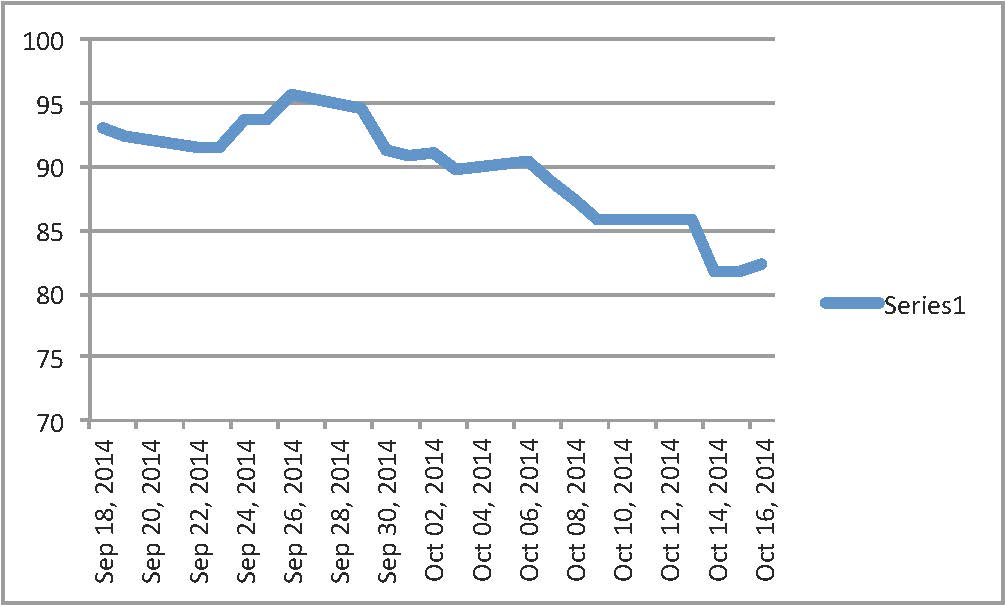
As the chart shows, for many decades the price of oil was below $50/barrel until the turn of the century, when the price rose over the course of ten years to a peak above $115/barrel. The price fell dramatically during the 2008-2009 recession. Until a few weeks ago it increased from below $40/barrel to a recent average close to  $100/barrel. The one hundred dollar barrel appeared to be the “new normal”, which encouraged US companies to pursue shale oil in North Dakota and more recently in the Texas. A few weeks ago the price started to fall:

WTI mid Sep-mid Oct 2014

This chart show the price of West Texas Intermediate (WTI) crude at the Cushing, Oklahoma terminal. Is this a trend that will continue? Why has it occurred? Who will benefit? These questions have been addressed by news articles and op ed pieces in a variety of outlets. National Public Radio aired a report on Saudi Arabia’s possible role in the fall of prices

http://www.npr.org/2014/10/16/356588376/crude-oil-prices-drop-as-saudis-refuse-to-cut-production

Thomas Friedman’s column in the NY Times suggests the Saudi’s are driving the price down through high production in order to reduce US shale oil production and to damage Iran’s ability to support Shia militants:

He also suggests that perhaps the US and the Saudi’s want to damage Russia’s economy by reducing its revenues from oil exports.

The Financial Times, the Wall Street Journal, and many other papers have run similar stories. Many stories claim that the decline in economic activity in Europe and China during the past six months hasreduced demand for oil, and thus caused the price to fall since the beginning of the year. Is this true?

Regarding China’s oil consumption, Platt’s reports that China has imported 7.4 percent more oil for the 12 months ending September 30 than it did a year earlier. China’s average import was 6.74 million barrels of oil per day. This was 13 percent higher than in August, 2014.

http://www.platts.com/latest-news/oil/singapore/chinas-september-crude-oil-imports-rise-7-on-27719307

Regarding Europe, the International Energy Agency (IEA) reported in September that first quarter 2014 consumption was 13.7 million barrels per day (mmbpd), second quarter consumption was 14.1 mmbpd, and third quarter was estimated to be 14.6 mmbpd.

Falling demand in China and Europe is not depressing prices.

The IEA also reports falling supplies in August. These are due in part to seasonal maintenance in several producing countries, and a smaller call for deliveries of crude from Saudi Arabia.

http://www.iea.org/oilmarketreport/omrpublic/currentreport/#Supply

Economic data is always retrospective. Reports of production and consumption arrive well after the crude has been pumped from wells or delivered to refineries. In a few months we will have a better idea how much oil is being supplied and consumed this autumn.

What happens if crude oil prices remain low? This topic also generates opinion pieces. The Guardian had piece with one interesting graphic:

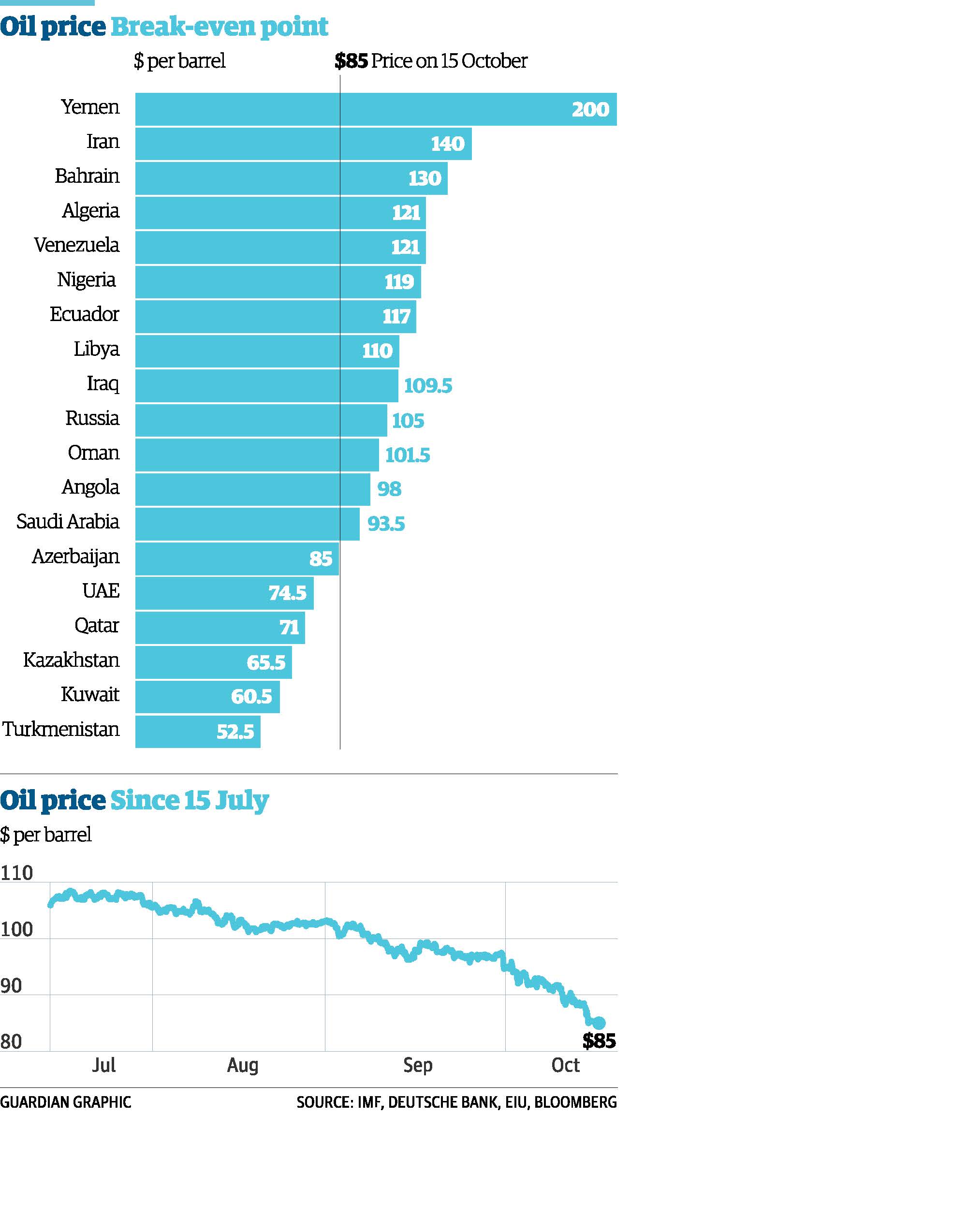
break even oil_prices


http://www.theguardian.com/news/datablog/2014/oct/16/datablog-low-oil-prices-chill-producer-economies

The bar graph at the top of figure shows the price of oil needed for producers to break even in 19 exporting countries. Published on October 15 when the price for WTI was near $85/barrel, it shows that Iran loses perhaps $50/barrel. Iran produces oil from a number of fields, and no doubt some fields break even below $85/barrel. But the chart indicates that some, perhaps most, of Iran’s fields will lose money if recent prices persist. Likewise, Russia loses about $20/barrel at recent prices. However, Russia produces oil from many fields. No doubt some fields lose money at recent price levels, but others will remain profitable. Low prices will damage Russia’s foreign income.

As for Saudi Arabia, if it does play an active, deliberate role in driving prices down, it has some fields that lose money, but most will make money. With substantial foreign reserve holdings, it may be able to live with low prices for a longer period of time than other members of OPEC.

As for US oil shale, the cost of lifting a barrel of crude vary within basins from $60 a barrel to $80 a barrel. If low prices persist, then investors in US shale projects will find less comfort with these project than when the price was a the “new normal” of $100 a barrel. As the perception of risk in shale oil projects rises, some investors will look for projects in other fields.

OPEC energy ministers will meet in Vienna on November 27. Statements made before and after meeting may provide some guidance about future production trends. These statements may hint at political conflicts between member states, and between OPEC members and other producing countries.


Oil Price Forecasts: An Example from 1983


The Hubbert peak oil forecast assumes the production of oil (or gas or other commodities) follows a logistics curve from initial production to final resource exhaustion. The area under the “Hubbert Peak Oil” curve represents the total oil to be produced, or the total oil resource that has and will be exploited. The curve represents the volume of oil produced per unit time. In most forecasts, years or decades represent the unit time. We can read the curve as barrels of oil produced per year or per decade.


Economists consider supply and demand to be functions of price. The volume of a product consumed in day or a year or other time period is thus considered to be a function of the average price for that time period. If we want to perform a forecast of peak oil or ultimate oil consumption for a oil producing province, or a country, or the world, then we would like to have a forecast of the oil price for the remaining history of oil production. This is a difficult problem. Consider an example from 1983:

BrentPrice

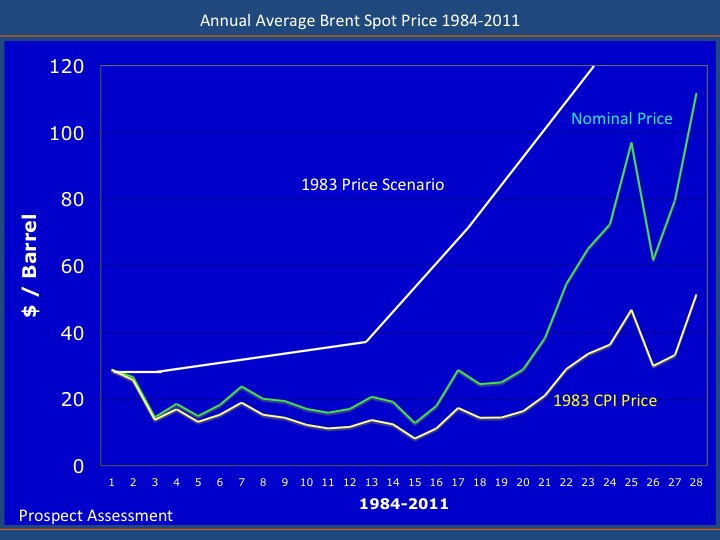
The figure shows a price forecast made by a major oil company. It was used to evaluate potential projects in a variety of basin and countries. It was also used to forecast company revenues from existing production. Discussions with colleagues working in  other companies and host governments at the time suggested that this scenario was similar to scenarios used throughout the industry.

At the time of the forecast, Brent crude traded for about $30 a barrel. Although the price was forecast to remain flat for a few years, by 1986 it was expect to begin rising modestly each year until about 1997. From then until the end of the forecast period, it was forecast to rise to $120 a barrel.

The figure shows the actual price oil in nominal terms through 2011. The nominal price of oil fell to below $20 a barrel for 16 years, with only a few brief intervals above $20. It reached its nadir in December, 1998 at less than $10 a barrel. (http://www.eia.gov/dnav/pet/hist/LeafHandler.ashx?n=PET&s=RBRTE&f=M)

From then it rose, with one pause, to over $100. Although it never averaged $120 per barrel for an entire year, it did average over $120 a barrel in April 2011 and March 2012.

Nominal prices do not reflect inflation. For much of the forecast period inflation fell, becoming quite low in recent years. Using the CPI to discount the nominal price to 1983 dollars shows the price never came close to $100 a barrel, and has only recently approached $50 a barrel in 1983 dollars.

From today’s perspective, the error in the 1983 forecast may seem obvious. Oil production was increasing in North America and the North Sea at that time. OPEC members were cheating on their quotas. The high oil prices of the previous decade led to increased transportation fuel efficiency, as well as fuel substitution in many sectors of the economy.

In 1970, however, it seemed that oil would remain below $5 a barrel for many years. The Arab oil boycott just a few years later was not foreseen. For many years a nominal price above $3 a barrel seemed far fetched.

Not knowing the future price of oil, it is very problematic to assume the future production of oil will follow a simple logistic curve. This should give pause to those who predict either a near term collapse in production or a future with abundant supplies.


The Problem with OPEC Reported Reserves

MEOilReserves OPED

The Organization of Petroleum Exporting Countries (OPEC) uses the share of total proven reserves to allocate production quotas among its members. The proven reserves are reported by each member country to OPEC. The country with the largest reserves is granted the largest share of the quota. From the founding of OPEC, Saudi Arabia has reported the largest oil reserves.

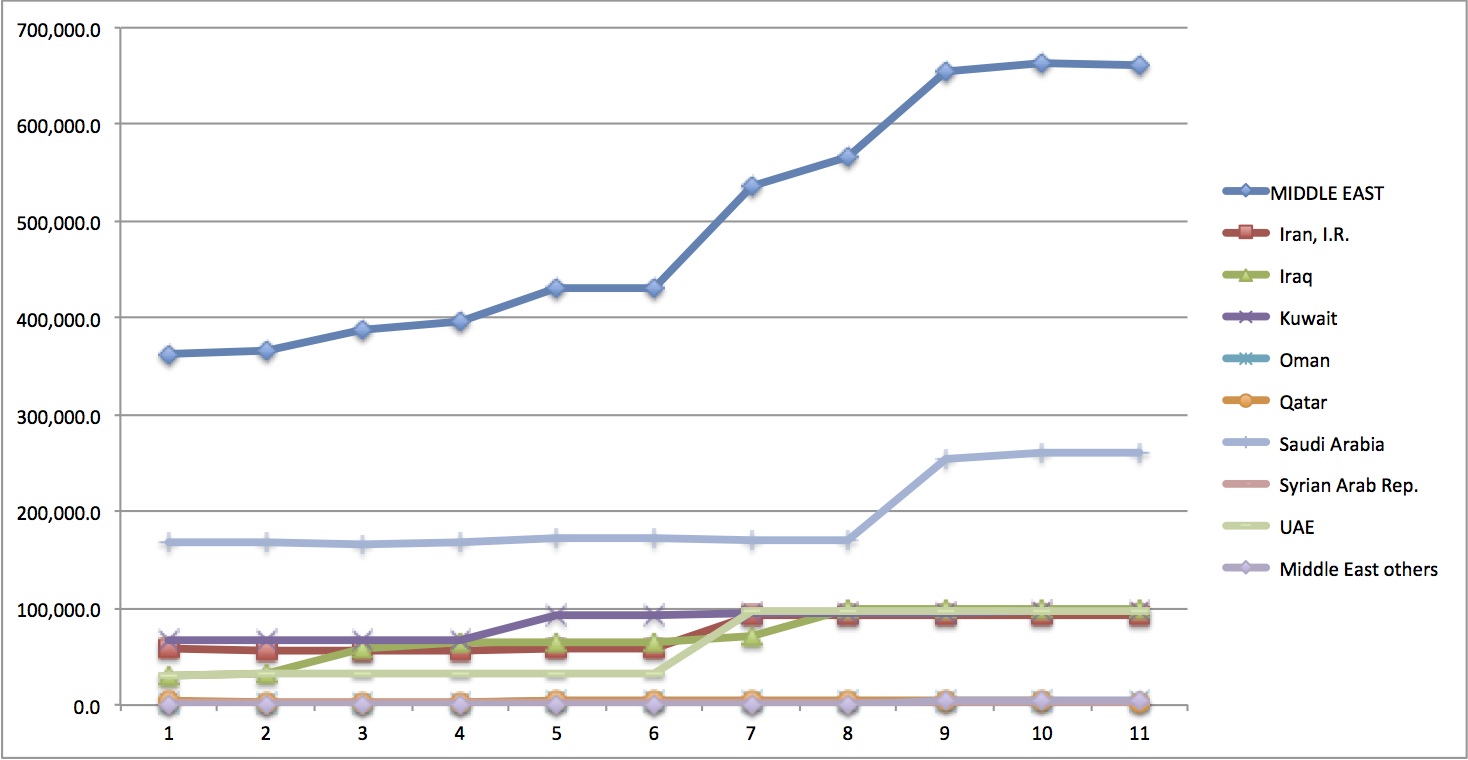
The figure at the top of this post is an Excel graph made from data reported by OPEC for the entire world. The spreadsheet is found here:

http://www.opec.org/library/annual%20statistical%20bulletin/interactive/2004/filez/XL/T33.HTM

The units shown on the vertical axis are in thousands of barrels of oil. The horizontal axis shows eleven years from 1980 thru 1990. Between 1983 and 1984, Kuwait’s reserves jump from 67 billion barrels to 92.7 billion barrels. The Wafra oil field was discovered in 1984 and accounts for this increase.

Between 1985 and 1986 Iran’s reported reserves jumped from 59 billion barrels to 92.86 billion barrels. Iraq’s oil reserves jumped from 72 billion barrels to 100 billion barrels. Iran and Iraq were engaged in a protracted land war between 1980 and 1987, hindering exploration in both countries.

The United Arab Emirates reserves jumped from 32.9  to 97.2 billion barrels. Between 1987 and 1988 Saudi Arabia reported reserves jumped from 169.6 to 255 billion barrels.

These very large oil reserve additions should reflect the discovery of very large oil fields.  Although a number of discoveries were reported during the 1980’s, none approach the size of pre-1980 discoveries. So perhaps the increased reserves reflect improved oil recovery techniques.

Skeptics hold a different view.  Consider the oil price history reported by the EIA for this period:

http://www.eia.gov/dnav/pet/hist/LeafHandler.ashx?n=pet&s=isa4990008&f=a

The average price of Saudi light crude landed in the US in 1982 was $35.65/barrel. In 1985 it was $25.35/barrel. In 1986 it was $13.05/barrel. In 1988 it was $14.04/barrel. The skeptics claim the increased reserves reported by OPEC countries, especially those in the Middle East, were not due to major discoveries or improved recovery techniques.

The skeptics claim the reports were a response to declining oil sales revenues. The falling oil prices reduced oil revenues, so OPEC agreed to reduce its production in order to restore higher oil prices.  Rather than accept lower production quotas, member states increased their reported reserves in order to obtain larger shares of the reduced quotas. As their reports are not audited by OPEC, no one outside of the state oil ministries really knows what their proven oil reserves are.

And without a reliable estimate of proven global oil reserves, it is not possible to perform a global peak oil forecast using the method employed by M. King Hubbert.