The New York Times, among many other news outlets, reported on the September 21 People’s Climate March:
I have nothing to add to these reports, and nothing to report about the much smaller march in Portland, Oregon:
http://koin.com/2014/09/21/climate-march-in-portland-hold-polluters-accountable/
Climate change is a serious problem that needs to be addressed. The changes in atmospheric composition since the industrial revolution have created a greenhouse effect, as predicted by Svante Arrhenius. The principle gasses contributing to the effect are carbon dioxide and methane. The largest human made source of carbon dioxide is due to the combustion of coal, oil, and natural gas. Significant methane releases are due to production and handling of these fuels.
How much of these fuels does the US use? What are they used for? The DOE’s Energy Information Agency compiles data from which two figures are published each year.
http://www.eia.gov/totalenergy/data/monthly/previous.cfm
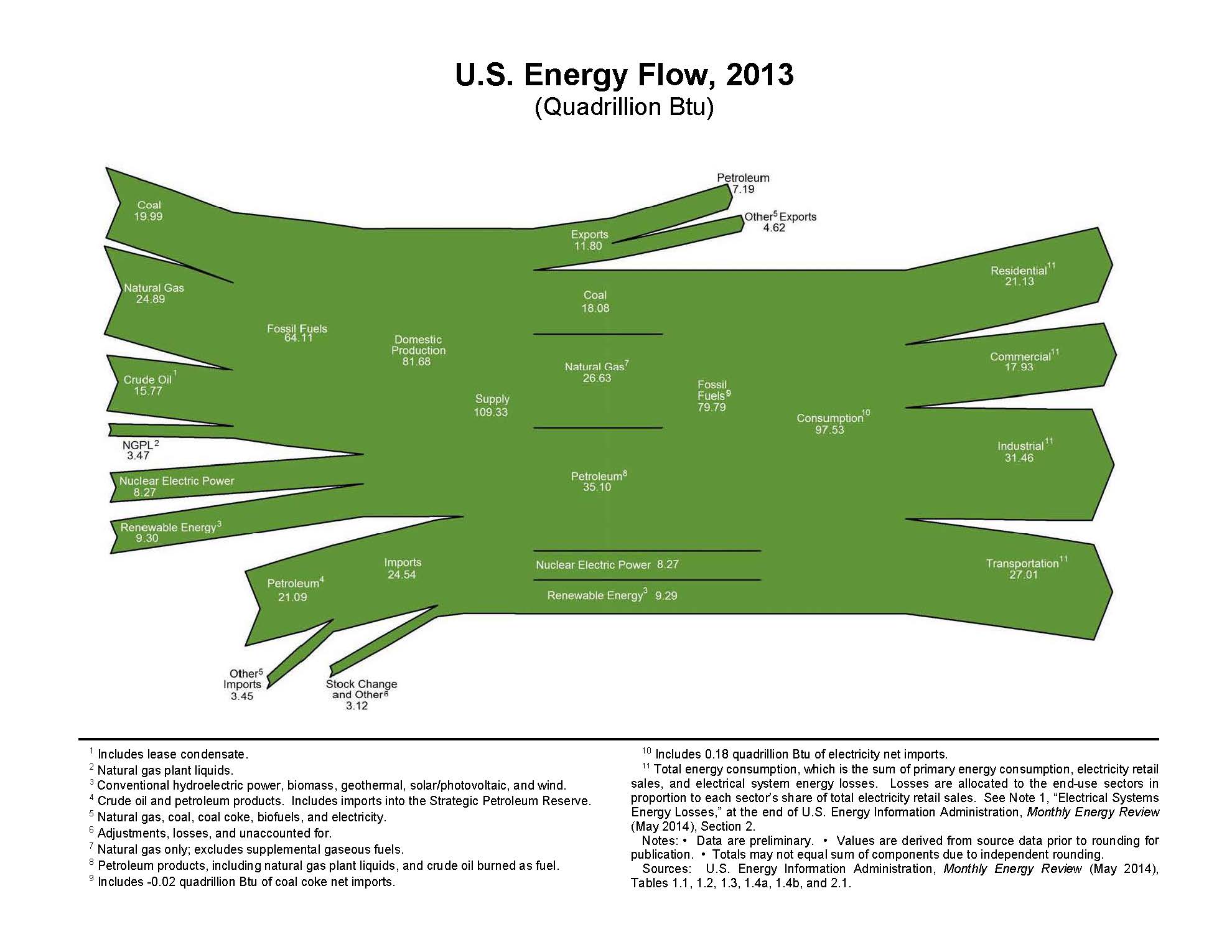
The figure shows sources of energy used during 2013 in the US. Natural gas is the largest source at 24.80 quadrillion BTU (quads). Petroleum Imports is the second largest at 21.09 quads. “Petroleum Imports” refers to crude oil, natural gas condensate, and all refined products, including gasoline, diesel fuel, bunker fuel, etc. Coal is the third largest source at 19.99 quads. US crude oil production is fourth at 15.77 quads. Natural gas liquids (NGPL) is a minor energy source at 3.47 quads. Nuclear power provides 8.27 quads, and renewable energy (hydropower, biomass, geothermal, solar/photovoltaic) provide 9.3 quads.
The chart shows that some energy is exported, a total of 11.80 quads. Thus the total US energy supply in 2013 was 97.53 quads. Fossil fuels supplied 79.79 quads, or about 82 percent of US energy. Replacing a significant fraction of these fossil fuel supplies is a daunting task.
Where does the US use these energy. The EIA supplies a figure for this too:
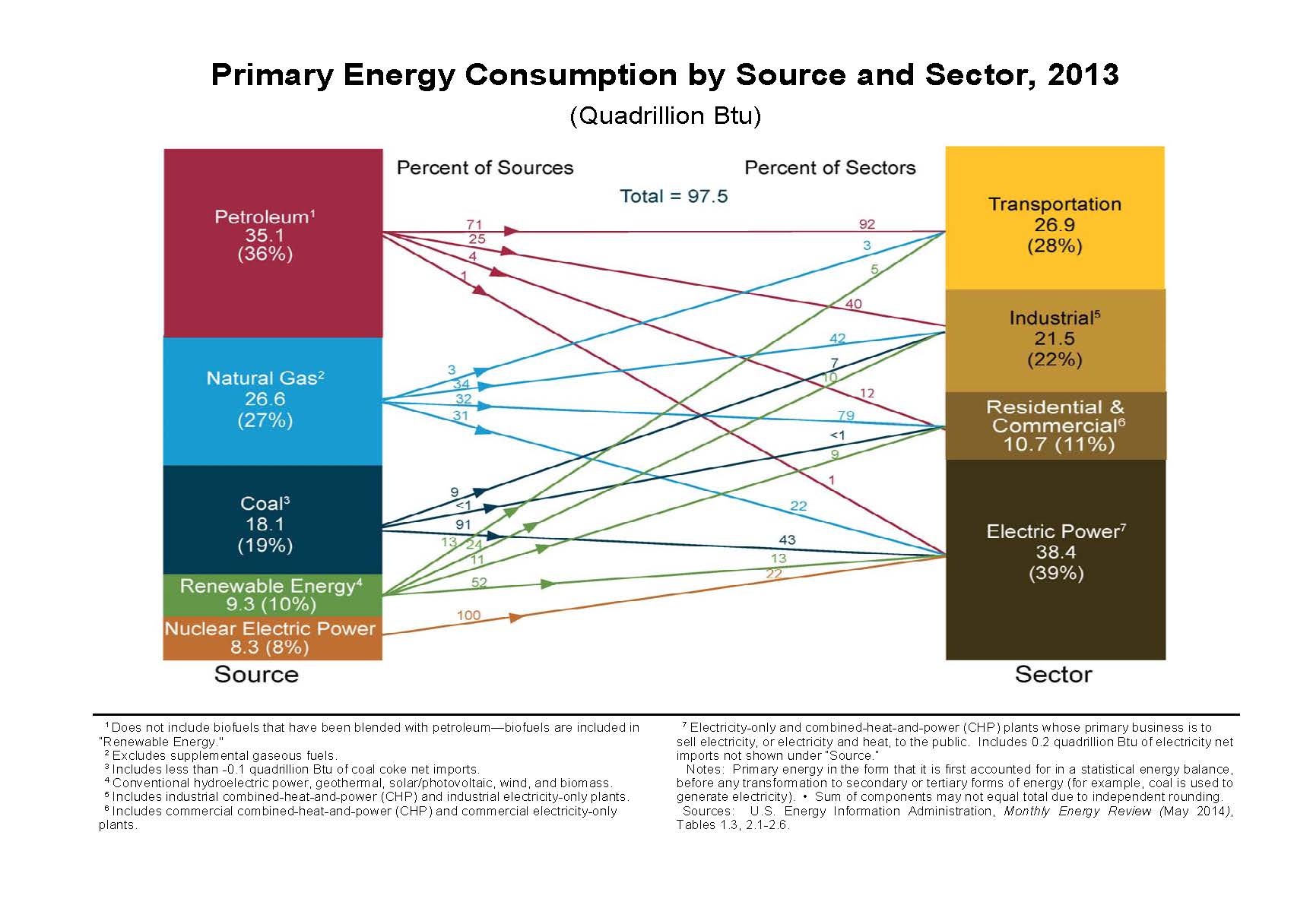
As this figure shows, transportation uses 26.9 quads. Petroleum supplies 92 percent of transportation energy. Transportation uses 28 percent of US energy.
Industry, including manufacturing, heating and electricity for factories, uses 21.5 quads, or 22 percent of US energy.
Stores, houses, and apartments account for 10.7 quads, or 11 percent of total US energy.
Electric power generation is the largest user of energy in the US at 38.4 quads, or 39 percent of total US energy. Over 90 percent of coal is used for electric power generation.
Natural gas is used in three sectors of the economy in almost even quantities: 34 percent by industry, 31 percent in electric generation, and 32 percent for heating houses, apartments, and stores.
Reducing crude oil consumption calls for a radical change in the US transportation system. Reducing coal consumption in favor of renewable energy calls for an equally radical change in the production of electricity. Reducing natural gas consumption calls for changes in almost every sector of the economy.
These two charts make one thing clear: there is no easy solution to the US carbon dioxide and methane emissions problem.
 consumingtheearth